

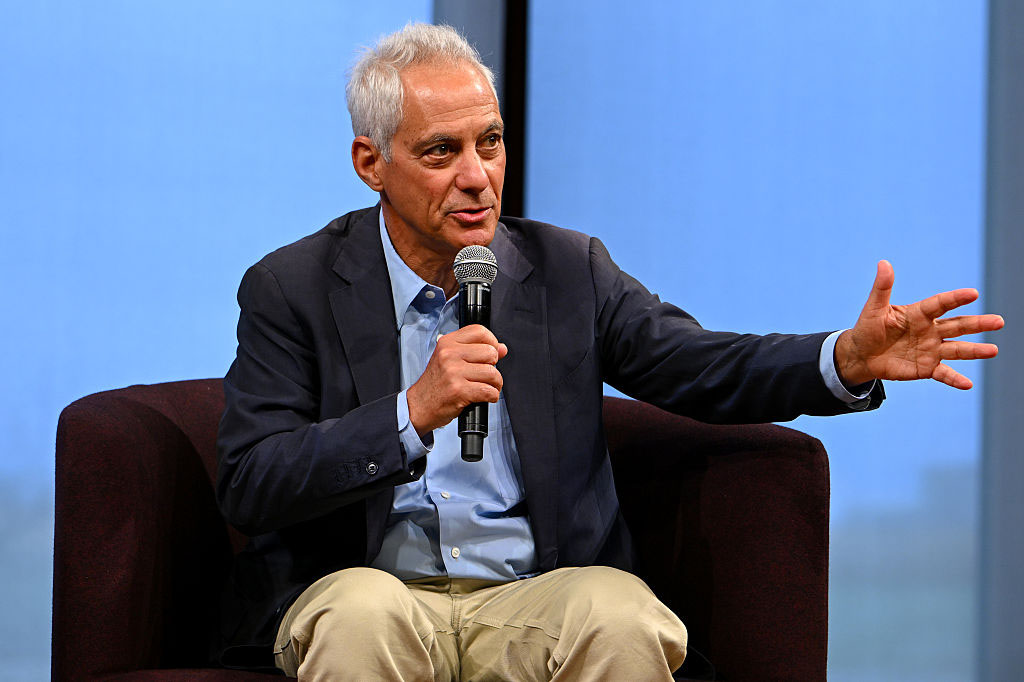
On Jul. 8, 2026 former White House chief of staff, once Chicago Mayor, and possible Democratic presidential candidate Rahm Emanuel gave a speech at Tel Aviv University about U.S.-Israel relations. He did not hold back.
Emanuel begins by stating that he understands why Israelis might dismiss criticism from outside. Palestinian leaders, after all, have refused offer after offer of “sovereignty in exchange for your security,” and each time, the offer was not only rejected, but also Israel was “attacked as a direct consequence.”
Even so, Israel has become, not a start-up nation, but “a modern-day Sparta” (Netanyahu’s phrase) and even worse, “a territorial pariah.” While Emanuel does not excuse the Palestinians (more on that below), he blames Netanyahu and his government for leading Israel “into a dead-end.” Unconditional American support, Emanuel says, has led Israelis to treat Palestinians in the West Bank abysmally and with impunity. Consequently, support for Israel “is plummeting around the world,” Israeli scientists “face exclusion from international research,” and artists and writers, as a recent PEN report stated, face “rising hostility and exclusion.”
And Emanuel, unequivocally and forcefully, blames Netanyahu, who failed to turn Israel’s “military wins into strategic advantages,” and even worse, “your government is complicit in the horrors now being inflicted on innocent families in the West Bank.” As a direct result of Netanyahu’s not just tolerating, but also encouraging, the worst aspects of Israeli politics, Israel has lost its legitimacy in the world’s eyes, and “you cannot fight indefinitely against a world that has stopped believing you have the right to fight.” By focusing exclusively on military solutions to security challenges, Israel is “more diplomatically isolated than ever. That is a choice this government has made.”
To be sure, Emanuel does not give the Palestinians a pass. Those chanting “from the river to the sea” are fanatics and “they will never have their way,” just as those calling for a “greater Israel” are fanatics who will never have their way. The Palestinian leadership has repeatedly rejected Israeli offers for peace, which is why “Arab leaders, not Israel, must hold the Palestinians responsible and accountable for their actions.” Palestinians and Arab leaders must accept “the historic Jewish connections to this land,” and they must “put an end to the heinous practice of financially rewarding terrorist who kills Jews. And they must stop teaching young children to hate Israelis.”
But Emanuel devotes the majority of this speech to criticizing Netanyahu and his policies, which brings me to the IHRA definition and the false charge that the IHRA definition conflates criticism of Israel with antisemitism. There are endless examples, so let me give a representative one. In his recent book, “Israel: What Went Wrong?,” Omer Bartov asserts that the IHRA definition has “morphed into an instrument for silencing criticism by law and duress” by “defining criticism of Israel as antisemitic.”
But Bartov is wrong, as are the many others who claim the IHRA definition conflates criticism with antisemitism.
Here’s the relevant text part of the IHRA definition: “Criticism of Israel similar to that leveled against any other country cannot be regarded as antisemitic.” It’s only when the Jews are blamed when “things go wrong” or one applies “double standards by requiring of [Israel] a behavior not expected or demanded of any other democratic nation” that speech veers into antisemitism.
Whether or not you agree with Emanuel’s diagnosis and his solutions, you cannot say that he’s not harshly critical of Netanyahu and Israeli policies. He is about as clear as can be that Israel’s actions post-10/7 have been disastrous for Israel’s reputation, and while he does not say so explicitly, we can safely assume that he hopes Netanyahu loses the next election.
Whether or not you agree with Emanuel’s diagnosis and his solutions, you cannot say that he’s not harshly critical of Netanyahu and Israeli policies.
But it’s equally clear that his speech has not been silenced. He was invited to Tel Aviv University to give this speech, and surely, everyone involved knew what he was going to say. Nobody claimed that his speech was either antisemitic or aided and abetted antisemitism. And nobody said that Emanuel should not have been allowed to give this speech.
That’s because Emanuel criticizes Netanyahu in exactly the same way that Democrats criticize, say, Trump’s immigration policies. Or Republicans criticized Biden for his immigration policies. What Emanuel does not do is state that Israel is committing genocide, or that Israel does not have a right to exist. That would be, according to the IHRA, stepping over the line.
And make no mistake, there is an astonishing rise in antisemitism today. Egypt loses a soccer game, and Egyptian fans blame Zionism. Crowds at the San Fermin bull run unfurled, to massive cheers, a giant banner reading “Destroy Israel.” PEN released a report detailing “the blatant hostility, discrimination, and hate that some Jewish and Israeli authors are facing,” regardless of their views on the Gaza war. PEN America’s president, Dinaw Mengestu, resigned because he regarded the report “as a possible threat to the constitutional rights of those who advocate for shunning Israeli products.” Even though PEN is against censorship and boycotts, when it comes to Jews, Mengestu is okay with “work that might actually restrict or limit or suppress what is constitutionally protected speech.”
These three examples (and believe me, there are more, lots more) are what the IHRA definition targets as antisemitic. But as Emanuel’s speech shows, criticism of Israeli policies, no matter how fervent, is perfectly within bounds.
Claiming that the IHRA definition silences Israel’s critics is simply wrong. The IHRA definition, instead, draws a bright line between what is and is not antisemitic. That’s why it’s essential today, more than ever.
Peter C. Herman is Emeritus Professor of English Literature at San Diego State University. His last publication with the Jewish Journal of Los Angeles is “The Phoenix of Gaza Exhibit: Education or Indoctrination.”