
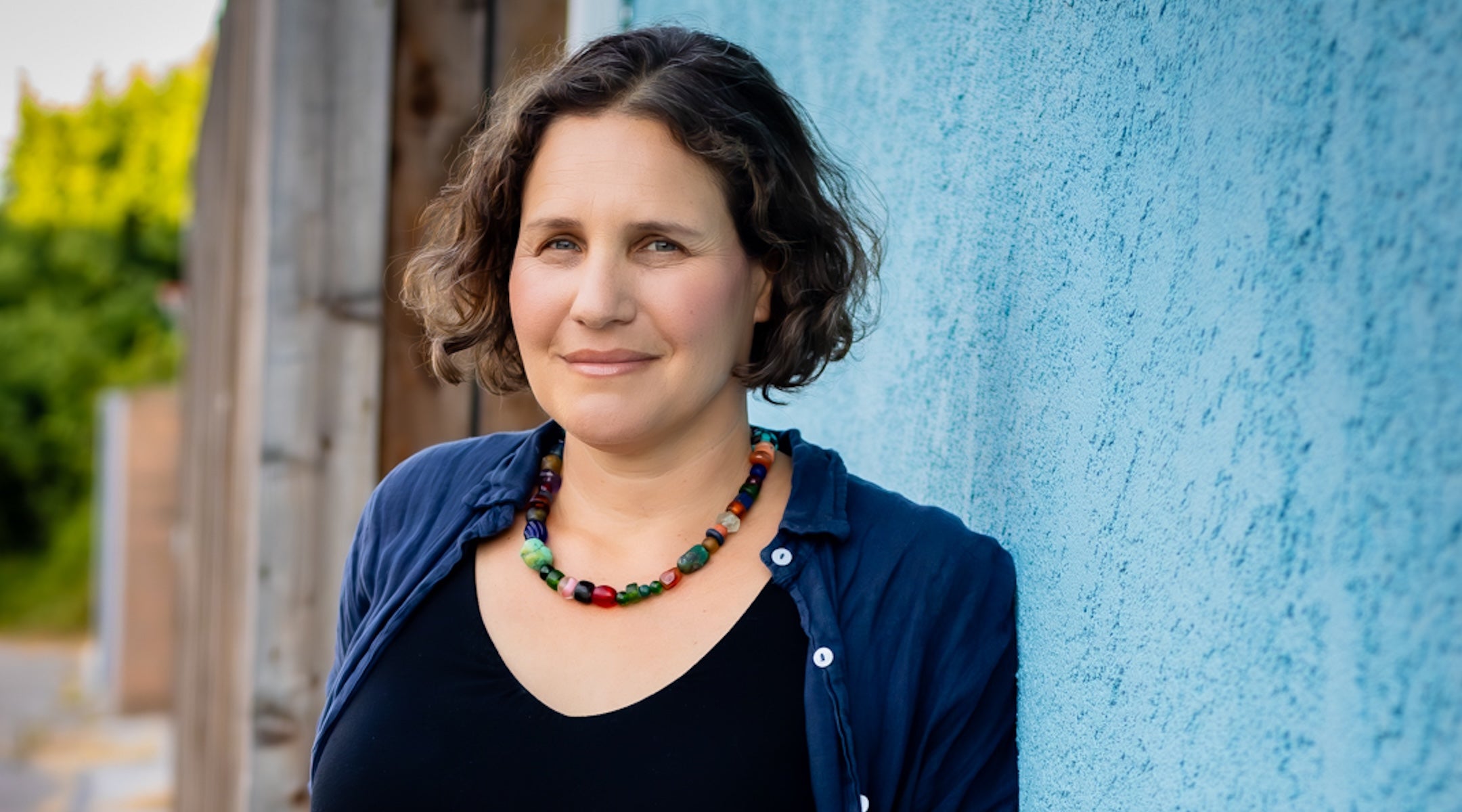
Like many Holocaust survivors, Daniela Gerson’s grandparents lived by the vow to “never forget, never forgive” the annihilation of their Polish Jewish hometown at the hands of the Nazis.
They took less interest in commemorating their own story of survival by leaving their beloved Zamość, Poland. Before understanding the mass extermination to come, they escaped to the Soviet Union — a route that turned into a decade of wandering exile, from Siberian labor camps to Central Asia and displaced persons camps in Austria and Germany.
Gerson, an immigration reporter and professor of journalism at California State University, grew up in Washington, D.C. Her Holocaust education detailed survivors who emerged from the concentration camps, hid in attics and forests or posed as Christians. She believed her family’s odyssey in the east was relatively rare.
Only recently did Gerson learn that her grandparents were part of the largest group of European Jews to survive the Holocaust. The Nazis killed 90% of Poland’s Jews. Most of those who survived — nearly 300,000 — fled east in 1939 to the Soviet Union.
Gerson chronicles her family’s not-so-unique journey in her new book, “The Wanderers.” This blend of memoir, history and journalism took her to Zamość, Ukraine and Uzbekistan. (The Russia-Ukraine War prevented her from visiting Siberia, where Stalin sent her grandparents to labor camps.)
“I knew that my grandparents had survived in Siberia in forced labor,” Gerson told the Jewish Telegraphic Agency. “That was their story, but I didn’t see their story anywhere.”
The New York Jewish Week will host a free, online conversation with Daniela Gerson about “The Wanderers” at 6 p.m. ET on Wednesday, June 10. Register here.
Her investigation of the past began with a modern-day love story. To her own surprise, having expected to marry a nice Jewish man, she fell for a nice Jewish woman: Talia Inlender, an immigration attorney. And in perhaps as great a surprise, Gerson discovered that Inlender’s grandfather came from the same town as her own grandparents, Zamość, where their houses stood about 100 steps from each other across the town square.
Daniela Gerson and Talia Inlender traveled with their children to Zamość, Poland, to investigate their families’ intertwined past. (Daniela Gerson)
Gerson was even more stunned to realize that Inlender’s family took nearly the same path as hers. Both of their grandparents made the calculation to cross the border to the Soviet Union during a brief opening in the fall of 1939, after Stalin and Hitler carved Poland between them.
Both families became refugees at the same time in current-day Lviv in western Ukraine. They suffered from hunger and disease, which killed Mottel and Peshke Gerson’s firstborn child, Daniela Gerson’s uncle Arik. They saw other Polish citizens, accused as threats to the Soviet Union, arrested and disappeared by secret police. So when the Communists offered them a choice between Soviet citizenship and returning to Nazi-occupied Poland — not knowing what the future would hold — the Gersons and the Inlenders, like thousands of other Jews, said they wanted to go back home.
But the offer was a trick: Stalin declared that the Jews who applied to leave were traitors and security risks. In 1940, they were deported in cattle cars to the Ural Mountains, where both families found themselves in forced labor camps in the Sverdlovsk province.
A year later, their fates changed again when Hitler broke his pact with Stalin and the Nazis marched into Lviv. Behind the Gersons and the Inlenders, the Jews left in Zamość and Lviv would be systematically killed. Meanwhile, they transformed from Gulag prisoners into comrades. Britain, which housed the Polish government in exile, agreed to team up with the Soviet Union on the condition that Polish prisoners were freed.
Thus began years of trekking for the Gersons and the Inlenders through the Soviet Union’s Central Asian republics. Thousands of Jews migrated through Kazakhstan, Uzbekistan and Turkmenistan. They continued to fend off hunger, illness and arrests, surviving on the black market.
At the end of the war, the Gersons and the Inlenders briefly returned to Poland, though not to Zamość. They went to western Poland, which appeared to boast a Jewish revival. That was until antisemitic pogroms pushed them west again, and they arrived in displaced persons camps in Austria and Germany.
Finally, 10 years after leaving their homes in the Zamość town square, the two families’ paths moved far apart. The Inlenders immigrated to Israel in 1949 and the Gersons to the United States in 1950.
Gerson’s and Inlender’s fathers were both born during this long limbo. Allan Gerson, who would become a lawyer bringing Nazi war criminals to justice, entered the world in an Uzbek village. Nachum Inlender, an entrepreneur, was born in an Austrian displaced persons camp. He moved to the United States to study in his 20s, setting the stage for their daughters to meet in Los Angeles decades later.
Both men also died within years of each other, Nachum Inlender in 2016 and Allan Gerson in 2019.
The twists of history that saved the families also wound up obscuring their stories. In the postwar period, the Soviet Union celebrated its victory over the Nazis and its liberation of the death camps, a narrative that left little room for Soviet persecutions of Jews. After the Soviet Union fell, Poland saw growing efforts to unearth Holocaust memory — but those were soon clouded by a nationalist right-wing government from 2015 to 2023, which advanced a version of history focused on Polish victimhood and resistance. A member of that political movement was elected president last year, once again setting back research on Polish Jewish history.
In the United States, Stalin was briefly portrayed as a heroic “Uncle Joe” in a triumph of good over evil. Then, with the advent of the Cold War, Gerson said her grandparents sought to hide any connections to the Soviet Union.
On a personal level, Gerson said her grandparents were intent on drawing attention to those who did not survive.
“They were consumed with guilt. I saw my grandfather focus on telling the story of the relatives who were left behind in Poland and who were killed,” she said. “If they were going to do commemoration, it would be focused on those who were murdered.”
Officially, families like the Gersons and the Inlenders were not recognized for many years as Holocaust survivors at all. When Germany began to pay reparations to survivors through the Claims Conference in the 1950s, Jews who fled east did not qualify. As a result, Inlender’s grandparents lied on their documents, saying that her grandmother survived two Lublin ghettos and her grandfather escaped from Zamość to the forest.
Gerson’s grandparents also spent years lying. When a family called Blumstein abandoned their papers to enter a German displaced persons camp, the Gersons adopted their identity. It was their only way in after the United States stopped permitting new admissions to stem the flood of refugees from the east. They lived illegally as the Blumsteins in New York until 1957, when a lawyer cleared them of the trespasses.
Gerson and Inlender, who have dedicated their careers to representing the experiences of immigrants to the United States, recognized the decision to lie.
“At a time when our country has closed its border to refugees, and calls other immigrants criminals who lie — knowing that my family lied, I have a much better understanding of why people lie,” said Gerson. “And it doesn’t make them bad immigrants. It might make them actually good ones who are working so hard to keep their families safe.”
Digging through visa applications, Gerson discovered that it was common for Polish Jews who survived in the Soviet Union to bend their identities in order to continue surviving and start new lives. While she empathized with such fabrications, they also complicated the historical record, as many “wanderers” themselves did not share their exodus as a survival story.
“There were all sorts of messages that you’re not a survivor,” said Gerson. “But if you’re not a survivor, what are you? You’ve survived the Gulag, you were in the Soviet Union, your family members were killed. And do you get to consider yourself part of the Holocaust?”
Reporting the stories that define our era. When history unfolds in real-time, the Jewish world turns to JR. Your support ensures we can document the complexities of war and the resilience of Jewish communities with integrity.