
Memoirs of leaving the Orthodox Jewish world have become a genre with their own familiar arc. The protagonist flees an oppressive religious world, is ostracized by family and former friends, and emerges into secular freedom — damaged perhaps, but liberated.
Readers consume these books partly as anthropology, partly as self-help and, critics sometimes complain, partly as validation of their own disdain for insular Orthodox communities.
In “Brooklyn Odyssey: My Journey Out of Hasidism,” Zalman Newfield hoped to tell a different story. Compared to classics in the genre, including Shulem Deen’s “All Who Go Do Not Return” and Deborah Feldman’s “Unorthodox,” Newfield’s is the kinder, gentler “ex-O” memoir.
While he admires such books, he said in an interview Wednesday, they “tended, for the most part, to give the impression that once people left the Hasidic community or the Orthodox community that they were raised in, they were shunned or completely disconnected from their family, and that was very much not my experience.”
Instead, “Brooklyn Odyssey” recounts his upbringing in the Lubavitch Hasidic community in Crown Heights, Brooklyn, and the eventual disillusionment that led him to defy communal norms and attend college. His parents were deeply pained when he left the community, shaved his beard and renounced many of the core beliefs of the movement.
Nevertheless, they remain part of each other’s lives, and Newfield, an assistant professor of sociology at Hunter College, remains engaged with Judaism on his and his wife’s progressive, egalitarian terms. His father even reviewed an early draft of the memoir and offered helpful suggestions.
“Those relationships, on the one hand, are a great blessing,” he said of his ties to his Lubavitch family. “And at the same time, they complicate our departure from Orthodox Judaism, because we have to kind of negotiate on a regular basis with our family that’s still Orthodox.”
Zalman Newfield’s memoir describes his journey from dutiful Hasid to a scholar charting his own intellectual and religious course. (Shulamit Seidler-Feller; Temple University Press)
Newfield, 44, grew up in the heart of Lubavitch Brooklyn, in a family of nine children. He attended yeshivas that taught virtually no secular subjects. As a teenager, “I couldn’t read [English] at all, really,” he said.
His parents were ba’alei teshuvah — newly observant Jews who grew up outside of Orthodoxy — who joined a community that revolves around ritual, Torah study and rigid dress and social codes. Unique among Hasidic groups, Lubavitch also trains its followers to go out into the world as missionaries intent on bringing non-Orthodox Jews closer to the fold.
Newfield can’t say precisely the moment he abandoned that path, although two traumas — one communal, one personal — surely played a part. In 1994, the Lubavitcher Rebbe — Menachem Mendel Schneerson — died after leading the community for over 40 years. His death devastated followers who were convinced that he would reveal himself to be the messiah, and many of them couldn’t let go of the idea. Newfield was 11 at the time, and while he was too young to appreciate the schisms in the community, he remembers asking how a core belief of his rabbis and teachers — that the Rebbe couldn’t die — could turn out to be false.
Five years later, his younger brother Shimmy died of leukemia, leading the teenage Zalman to ask the usual hard questions about God, faith and justice. “Only years later would I realize how much Shimmy’s death undercut my general belief in God’s very existence,” Newfield writes.
Over those years, thanks to his non-Orthodox relatives and his own budding curiosity, Newfield began to read secular books. Starting with illustrated classics, his English-reading skills slowly improved, and soon he was sneaking off from his yeshiva studies to read anything he could get his hands on.
Outwardly he was continuing the trajectory plotted out for him by his rabbis and parents: yeshivas in Chicago, Miami and Argentina, outreach internships in Singapore and Beijing, all leading to rabbinic ordination. And yet by his early 20s he knew he couldn’t be a dutiful Hasid, and shocked his parents with the news that he intended to attend college.
“This was a very, very slow and gradual process,” he said. “Certainly there are things that happened, like the Rebbe’s passing and Shimmy, my younger brother’s, passing, that were really devastating to me. But at the time when these things happened … I was nowhere near fully developed.”
Today, after earning a GED, a college degree and eventually a Ph.D. in sociology from New York University, he studies the very communities he once inhabited. His first book, “Degrees of Separation,” is based on dozens of interviews with those who have left Orthodoxy.
The memoir continues his exploration of how people form their identities. It is not, he says, a critique of the Orthodox world he grew up in.
“I never thought of the book as an exposé,” he said. “I never thought, ‘OK, this is my chance. I’m gonna stick it to them. I’m going to say everything that I think is wrong about Lubavitch.’”
Instead, he wanted to write “honestly and sensitively” about a community where his parents and most of his siblings are happy and thriving, and why it wasn’t for him. He writes how he envies the Lubavitchers’ belief in God, and the comfort and certainty that can provide.
Still, he talks and writes ruefully about the many Lubavitch boys who aren’t taught the rudiments of a secular education. And despite Lubavitch’s reputation for warmth and inclusivity, he came to regard the community as “austere and rigid.”
“My upbringing was just too narrow culturally, morally, and socially,” he writes.
If there was a unifying idea behind his eventual departure, he said, it was freedom — to read what he wanted, to make his own decisions, to be free of the “burdens placed on me by my community.”
Growing up, Newfield absorbed the Lubavitch notion of freedom, which teaches that human beings struggle between a “divine soul” and an “animal soul,” and that observing Jewish law frees Jews from their base desires. For years, he worried that his own doubts reflected moral weakness.
“Eventually I realized that I rejected this way of understanding human autonomy,” he said.
He came to believe that people could make ethical, meaningful choices outside strict religious boundaries. “I don’t see violations of halacha, of Jewish law, as being examples of succumbing to base desires,” he said. “In fact, I think that they may be morally noble.”
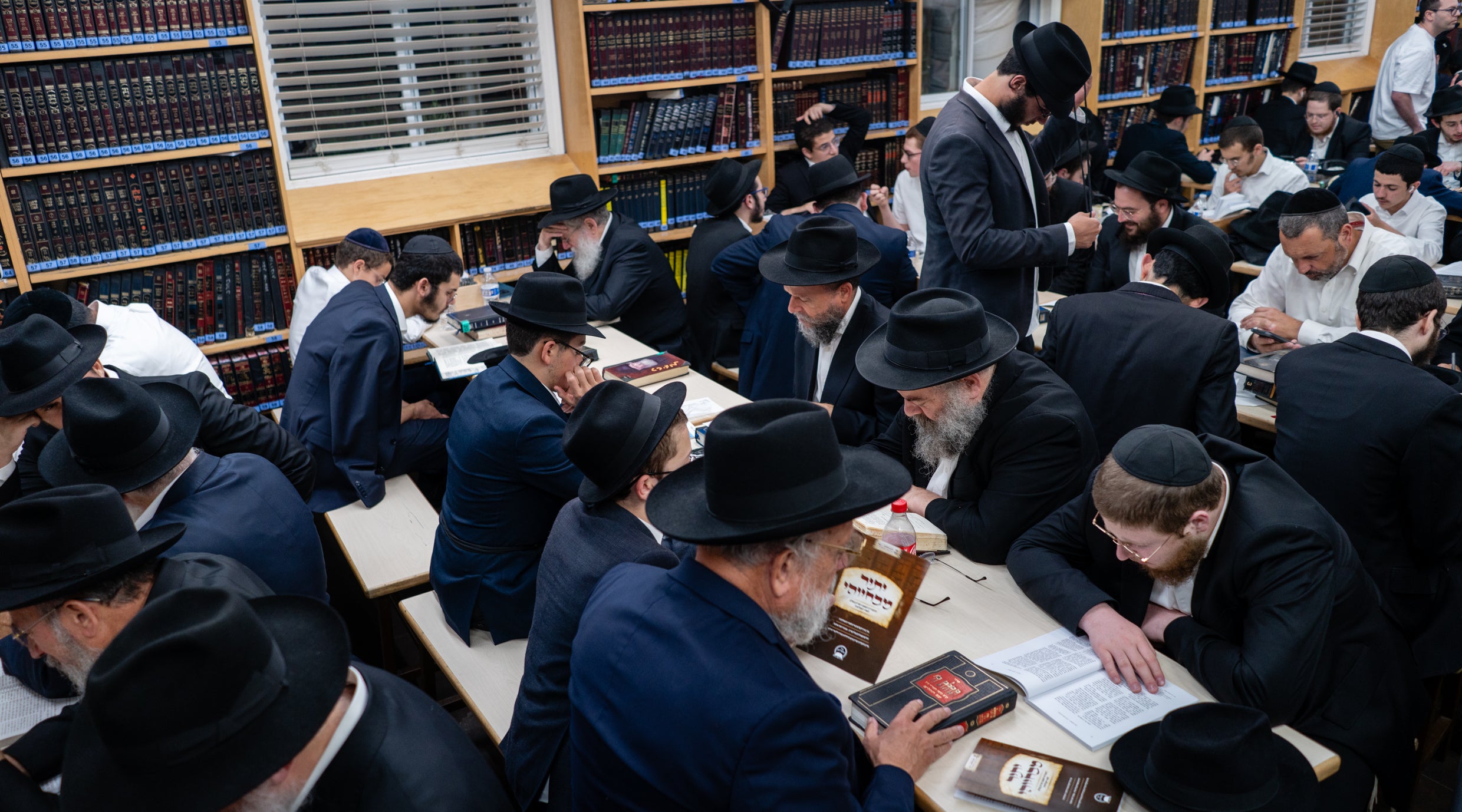
Members of the Chabad-Lubavitch movement study in preparation for a visit to the resting place of Rabbi Menachem Mendel Schneerson, the Lubavitcher rebbe, on the 30th anniversary of his passing, in Queens, July 8, 2024. (Luke Tress)
That intellectual shift did not sever his connection to Judaism. Unlike many who leave Orthodoxy, Newfield remains deeply engaged in Jewish life. He belongs to a progressive synagogue. He and his wife Jenny Labendz, a scholar of religion who received her Ph.D. from the Jewish Theological Seminary, have tutored their two daughters in Bible and Talmud.
In his academic research, he found that former Orthodox Jews take a variety of paths after leaving their communities. Some preserve the “all or nothing” mindset of their upbringing. Others become alienated from Jewish ritual because it carries traumatic associations.
“They just say, ‘I can’t walk into a shul again,’” he said.
He acknowledged that his own trajectory is not typical. “I would say a chunk of the people who leave end up more or less where I am religiously,” he said, “but that is not a dominant trend.”
Newfield attributes part of his own ability to maintain family ties, and to avoid bitterness, to therapy.
“I’ve been in and out of therapy for about 20 years,” he said. “I absolutely recommend therapy to everyone.”
At one point during the writing process, an early reader complained that the manuscript lacked sufficient rage.
“She said, ‘Where’s the anger?’” he recalled.
To recover the honesty needed for memoir, he said, he had to perform “a kind of emotional archaeology,” excavating feelings that no longer dominated his daily life. He shares the results with readers: At one point, unable to reconcile his hard-fought freedom with the guilt and turmoil he felt about disappointing his parents, he had suicidal thoughts.
The balance he eventually reached may help explain why he said some Lubavitch readers have responded positively to the book despite disagreeing with its conclusions. One former classmate told him he appreciated the memoir’s honesty and sensitivity.
“I think one of the criticisms against ex-Orthodox memoirists is, ‘Oh, they’re fabricated, this is not true,’” Newfield said. “I worked very, very hard to make sure that everything that I wrote was as accurate as possible.”
The memoir also arrives amid ongoing American Jewish anxieties about continuity and denominational decline. Newfield grew up hearing that only Orthodoxy, by erecting high walls between Jewish and secular culture, could preserve Judaism across generations.
Newfield offers a different approach: creating meaningful Jewish lives that children will actually want to inherit. “If you’re really concerned about Jewish continuity,” he said, “you should try to foster loving, healthy, harmonious Jewish households.”
The memoir is dedicated “to the brave souls who dare to be different,” and Newfield says he hopes it speaks beyond the ex-Orthodox world to anyone navigating profound personal transformation.
“It’s scary to change,” he said. “You have to deal with other people’s reactions to you, you have to deal with your own reactions to yourself and self-doubt and self-criticism.
“I’m hoping that my book could join the chorus of others who are trying to describe their major life transitions and give support to those who are going through it.”
Reporting the stories that define our era. When history unfolds in real-time, the Jewish world turns to (JR). Your support ensures we can document the complexities of war and the resilience of Jewish communities with integrity.