
JERUSALEM — Far-right activists chanted “death to Arabs” and engaged in violent clashes ahead of the annual “Dance of the Flags” march through the Old City that commemorates the reunification of Jerusalem during the 1967 Six Day War.
Journalists, left-wing activists and Arab residents all faced assaults during the march, in what police described as “isolated” clashes that led to the arrest of 13 people.
The celebratory march has a long history as a forum for violence carried out by far-right extremists often not quelled by police.
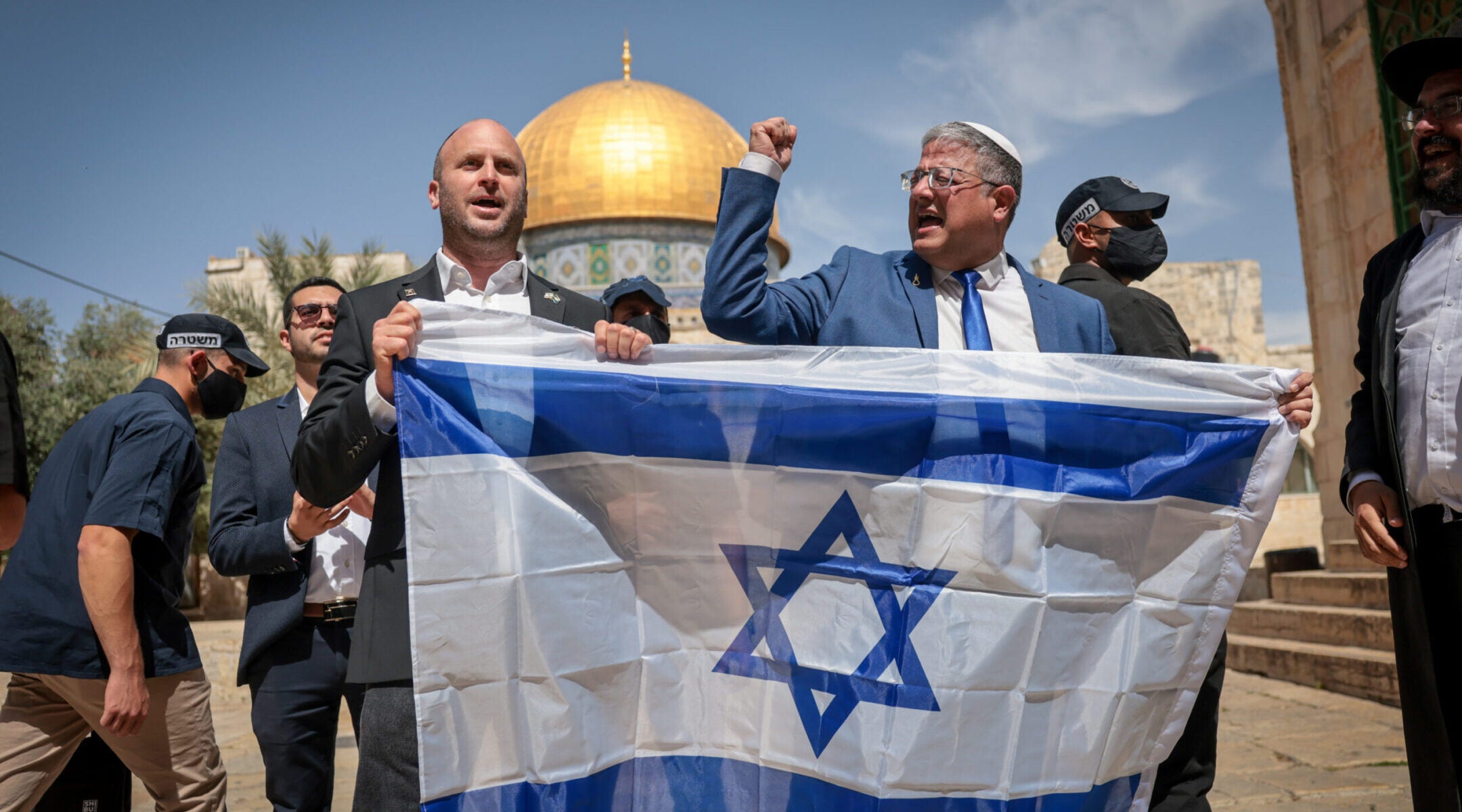
This year, the march followed a dramatic gesture by Israeli National Security Minister Itamar Ben-Gvir in which he displayed a large Israeli flag atop the Temple Mount and declared the site “in our hands.” Also known as the Al-Aqsa Mosque compound, the sensitive location is the holiest site in Judaism and the third holiest in Islam.
Ben-Gvir was echoing the words of Mordechai (Motta) Gur, commander of the 55th Paratroopers Brigade, after Israeli forces in 1967 entered the Old City and placed it under Jewish control for the first time since the destruction of the Second Temple in 70 CE.
Ben-Gvir’s display of an Israeli flag on the Temple Mount flouted longstanding norms against such displays on the site, in the kind of provocation that caused his critics to deride him as a “pyromaniac” before he became a crucial figure in the government’s ruling coalition three years ago.
Tag Meir’s Gadi Gvaryahu gives instructions to a crowd of peace activists before leading a march into the Old City of Jerusalem, May 14, 2026. (Theia Chatelle)
A spokesperson for the Israel Police, which falls under Ben-Gvir’s oversight, said ahead of the march that he anticipated a positive focus for the day.
“The main focus of today is heritage and unity,” Daniel Eldunne, the force’s international spokesman, told the Jewish Telegraphic Agency in an interview at the Damascus Gate. “We have already seen a few isolated incidents of violence, but it’s important to know that this is not what today is about, and it should not overshadow the day’s festivities.”
He added, “There are a few young individuals acting disorderly, but the Israel Police know how to handle them.”
Yom Yerushayim, the national celebration of the reunification of Jerusalem, actually falls on Friday this year so the Flag March was held one day early. The march began at the Great Synagogue and traveled through the Damascus Gate to the Western Wall. Many Arab residents of the Old City chose to close their shops for the day.
-Flag-Day-Image-2-scaled-e1778798124231.jpg)
An Israeli police officer escorts an elderly man through a crowd of demonstrators inside Damascus Gate during the “Dance of the Flags” march in Jerusalem, May 14, 2026. (Theia Chatelle)
Tensions were already rising by mid-morning, with crowds of religious youth walking through the streets of the Old City. Dancing in circles and hoisting younger demonstrators onto their shoulders, the marchers’ energy was palpable. Many chanted “Am Yisrael Chai” but extremists at times also broke into chants including “Death to Arabs” and “May your village burn.”
A coalition of left-wing Israeli organizations also assembled in the Old City to demonstrate their support for Arab residents and offer a “protective presence” against the right-wing marchers.
“We are here to show that we will not abandon our neighbors,” said Ori Shaham, a spokesperson for Standing Together, the left-wing Israeli peace group, which brought 200 volunteers in bright purple vests to accompany Arab residents who might be at risk from the marchers.
In one incident circulated by Standing Together, right-wing demonstrators could be seen throwing chairs at members of the group and the Arab residents they accompanied.
-Flag-Day-Image-3-scaled-e1778796988558.jpg)
Young men wave Israeli flags outside Damascus Gate of the Old City of Jerusalem during the annual “Dance of the Flags,” May 14, 2026. (Theia Chatelle)
The group Rabbis for Human Rights said its contingent was assaulted by right-wing extremists who threw water bottles at them while yelling slurs. It posted a video showing police officers repelling its delegation, including Rabbi Jill Jacobs, head of the U.S. group T’ruah, from the Old City.
“Meanwhile, right-wing Jewish youth were allowed to run riot,” T’ruah said on Instagram.
Tag Meir, a coalition of left-wing Israeli groups, organized a parallel “March of the Flowers,” handing out flowers to Arab residents and shop owners who did choose to open for the day. Tag Meir founder Gadi Gvaryahu told (JEWISH REVIEW) that the flowers are “an apology for what is to come later in the day” and a signal of peace.
In a critique of the right-wing extremists, he said about Jerusalem Arabs: “We don’t need to show them every year that Jerusalem is our city. Jerusalem is ours. We don’t need to reoccupy it every year.”
Emad Abu Ahmad, who sells dishware in the Old City just a few hundred meters inside Damascus Gate, told (JEWISH REVIEW) that “Each year the activists come with flowers, and look, I already have enough to make a bouquet.” He gestured at his sales counter, filled with pink and blue flowers.
Many of the left-wing volunteers were older, in contrast to the makeup of the nationalist marchers who tend to be younger yeshiva students. Michal Cohen, who is from Australia and a member of Women Wage Peace, said she had participated in the Flag March herself decades ago. Now, she said, “I was so ashamed and embarrassed. … What you see on this day, all those young people acting as though it’s OK to diminish the rights of everybody else.”
While some participants in the Flag March carried Third Temple flags, signaling support for a messianic movement that seeks to build a Jewish temple on the Temple Mount, where Al-Aqsa Mosque now stands, others are political moderates who marched to honor Israeli soldiers who died fighting to capture Jerusalem in 1967.
That was the case for Yonatan, who joined the march from Kfar Saba and recalled listening to news of the war on the radio. “It means something to me to see the Israeli flag carried here,” he said.
Gavriel Chaskia, a recent immigrant from Panama, said his motivation for joining was simple and not political. “We wanted to see the flags at the Kotel, so we drove from Ra’anana to be here,” he said.
Reporting the stories that define our era. When history unfolds in real-time, the Jewish world turns to (JEWISH REVIEW). Your support ensures we can document the complexities of war and the resilience of Jewish communities with integrity.