

It has been a busy time for combatants and spectators in the campus free speech wars. As I was drafting a comment about the University of Michigan, we got word that Northwestern University President Emeritus Morton Schapiro canceled his plan to deliver an invited address and receive an honorary degree from Georgetown University Law School, after protestors made clear in a circulated petition that he was unwelcome because of his pro-Israel views (he has written eloquent commentaries on a range of topics, not all about Israel and the Middle East, for this magazine). The irony is thick: the University’s chosen substitute, former National Legal Director of the ACLU, is known for defending campus speech rights of people with antisemitic views. So it seems it’s not really about free speech in any pure or absolutist sense, but rather about protecting some speech some of the time, an odd interpretation of the First Amendment if I ever saw one. I’ve known Morty Schapiro a long time. The Georgetown graduates are missing a rare opportunity to hear from someone special. Hopefully some of them will go on to careers defending the Constitution and will remember this episode as evidence of how liberal democracy can buckle under the toxicity of ignorance and hypocrisy.
What happened in Michigan raises other complexities.
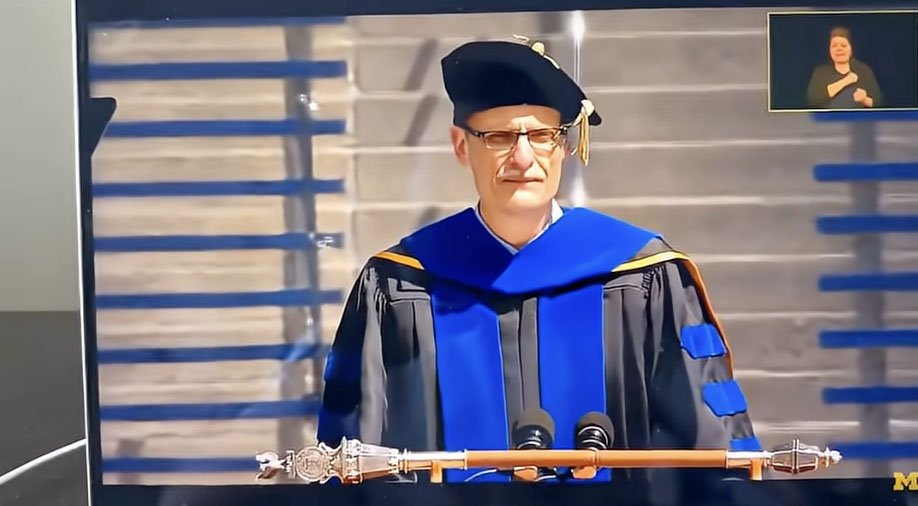
As reported in Inside Higher Education, history Professor Derek Peterson began his commencement address by doing what good history teachers are supposed to do: show how the past can help us better understand the present and think about the future. Peterson cited the denial of admission to women back in 1859 and celebrated one valiant dissenter and other suffragettes whose courage led eventually to the end of the university’s history of bigotry and misogyny. He correctly noted that freedoms we now take for granted were “hard won,” adding with some literary license that Michigan became “the greatest public university in the world” because people “refused to accept the enclosures and orthodoxies of the time.” He rose in praise of protest, worthy of remembrance especially as we celebrate our nation’s 250th anniversary.
And then he went off script. After acknowledging the fine decision of his University to admit Jews starting at the turn of the 20th century, and progress made over the decades since then to educate students on the “experience and identity of Black people in this country,” he called on the audience to “sing” for the “pro-Palestinian student activists who have over these past two years opened our hearts to the injustice and inhumanity of Israel’s war in Gaza.”
Not surprisingly, along with what was reported as “long and loud applause” Peterson’s remark prompted local and public backlash, although I suspect he wouldn’t cite those protestations in his next oration on the virtues of protest. In any case, it didn’t take long for attention to shift to Peterson’s right to speak and away from the content of his remarks. Let’s consider both those issues.
As heirs to the liberal tradition, we are often reminded of our obligation to defend people’s right to say even things we abhor. On the other hand, as the former Chancellor of the University of California at Berkeley once noted, “just because you have the right to say something doesn’t mean it’s right to say.” It is disappointing, to say the least, that someone like Peterson, crowned as a Macarthur “genius” in 2017, would place defenders of barbarous antisemitism, homophobia and misogyny in the same category with women, Black and Jewish civil rights heroes. Instead of fulfilling his professional obligation to challenge fashionable narratives, he encouraged more of what I’d call “the incredible lightness of being” unencumbered with evidence. He slid into mud that is usually the province of fanatics on social media, which raises a question much on the minds of many higher education leaders today: if we don’t provide something better than what’s on TikTok and Truth Social, how will we justify charging students $100,000 a year to get a bachelor’s degree?
As heirs to the liberal tradition, we are often reminded of our obligation to defend people’s right to say even things we abhor. On the other hand, as the former Chancellor of the University of California at Berkeley once noted, “just because you have the right to say something doesn’t mean it’s right to say.”
A related issue is Peterson’s deviation from the approved version of his remarks. Now, one might wonder if such vetting is in itself a violation of academic freedom. That’s a complicated question, although one wouldn’t know it from reading commentators with absolutist views. Academics are accustomed to having their words and ideas screened: anyone who has submitted an article to a reputable scholarly journal (not to mention to the op-ed pages of major newspapers) knows something about the three R’s: review, revision and rejection. Peterson breached his community’s trust: in exchange for a place on the commencement podium, he agreed to have his speech cleared in advance. That’s an implied social contract, which maybe as a historian, not a lawyer or economist, Peterson didn’t understand. Or maybe, like certain others these days who are overwhelmed by their own greatness, he just doesn’t think those rules of conduct apply to people of his rank and stature. (According to some reports, Peterson claimed that university officials knew he would mention pro-Palestinian protests, although he had agreed to remove the word “genocide” to “make it less provocative.” His perhaps extemporaneous remark, which he slipped in post-review, was certainly provocative enough.)
There is another ironic twist to this fuss. Many who remained silent or applauded Peterson quickly rose to protest U of M President Grasso’s dissent, which came in the form of an apology on behalf of the university. It brings to mind Winston Churchill’s wry observation that “some people’s idea is that they are free to say what they like, but if anyone else says anything back, that is an outrage.”
Finally, on Peterson’s gratuitous reference to the war in Gaza. I’m not trained as a historian, but I believe that history, like most disciplines, has (or used to have) standards of evidence. Peterson violated them in a short phrase about Israel that he packed with glaring errors of omission and commission: there is no mention of the possible “injustice and inhumanity” of the Oct. 7, 2023, attack that triggered the war, no mention of Palestinians and other Arabs who oppose the tyrannous barbarism of Hamas (including its vigilante executions of gays in Gaza), no mention of Israel’s efforts to protect civilian noncombatants (unprecedented in the history of modern warfare), no mention of the criteria used to judge Israel’s actions as “unjust,” no mention of Israel’s success in inoculating against polio more than 90% of Gazans under age 10, and no mention of Jewish students and faculty at Michigan and elsewhere who defended their right to a safe educational environment amid enraged demonstrators calling for dismantling of the Jewish State and global intifada. That would have been a lot to cram into a commencement speech; but if you can’t tell the whole story then you should be extra careful with half-baked ones.
No wonder the University wanted to review Peterson’s speech: maybe they feared that, yet again, factual knowledge might be displaced by trendy slogans, and they wanted to preempt further erosion to the integrity and reputation of their institution. If I were a parent paying big bucks for my child to attend Michigan, I would want to know if Peterson is an outlier (what I believe) or if his malpractice is more widespread (what we should all fear). I would want to know if and how the university is continuing to facilitate needed self-evaluation of its campus culture. Maybe we should thank Peterson for unintentionally alerting us to these issues? Regardless, we owe the University of Michigan leadership a real debt of gratitude for standing against such moral and intellectual inversions. Only such determination will save our truly great institutions of higher learning.
Michael Feuer is the Immediate Past Dean of the Graduate School of Education and Human Development and Professor of Education Policy at the George Washington University, past president of the National Academy of Education, and nonresident senior fellow at the Brookings Institution. The views expressed here are his own, and do not necessarily represent the school, the university, or its leadership.